Ludwig von Mises' private archive in Vienna and its relevance for economic policy and economic theory
An OeNB-Jubilee Fund research project to systematize and process Ludwig von Mises' estate from his time in Vienna
Workshop 16. & 17.02.2026
The Viennese Mises
The Vienna Private Archive and its relevance for economic policy and theory
Workshop 16-17 February 2026
Graz Schumpeter Centre, University of Graz
After Mises moved to Geneva in 1934, a stock of documents was kept in a room of Mises' apartment in Vienna. These holdings were confiscated by the Nazis in 1938. In 1945 the Red Army salvaged and took the materials to Moscow, where they were kept in a secret archive. Only after biliteral negotiations in the early 2000s could the documents be restituted to Austria, where they are now stored in the Austrian State Archive in Vienna. During our ongoing project at the Graz Schumpeter Centre that is funded by the Research Fund of the Austrian Central Bank we digitized the holdings and made them available online (https://privatarchiv-mises.uni-graz.at/en/).
Given the pertinence of the main topics of Ludwig Mises’ works, such as the dynamics of interventionism, monetary theory, the epistemological foundations of economics, questions of supra-national governance or his critique of centrally planned economics, his oeuvre is not only of historic interest but can also serve to inform present discussions. This holds, as we argue, especially for Mises’ more pragmatic approach during his time in Vienna. This time of his life was characterized by the unique intellectual milieu of Vienna, where Mises could draw from a variety of different influences. Most prominently, this has been the case in the famous Böhm-Bawerk seminar and Mises’ own highly influential Privatseminar. Here, discussions between intellectuals of distinct theoretical, epistemological and political convictions provided the scholars with a unique discursive setting to sharpen and test their ideas. It is, at least partly, due to this special environment, that the Viennese Mises, as opposed to the later Mises who was lacking this kind of tight-knit scholarly network, is particularly interesting.
Program:
Monday, 16 February:
13:30: Welcome address
HS 111.21, Beethovenstraße 8/2.
13:35-14:45: Session I – The Context
Lukas Starchl & Alexander Linsbichler (University of Graz & University of Linz)
A Brief Glimpse in the Mises-Privatseminar.
Richard Sturn (University of Graz)
Mises’ uniqueness: the economist as Viennese scholar of civilization.
14:45-15:00: Coffee Break
15:00-16:30: Session II – Theory and Action
Berthold Molden (University of Vienna)
Ludwig Mises, Benedikt Kautsky and the establishment of the Austrian Business Cycle Research Institute
Scott Scheall (University of Austin)
Liberalism’s Ouroboros: DOGE and the Transition Problem in Stark Relief (online)
16:30-17:00 Coffee Break
17:00-18:30: Session III – Axioms in Economics
Mario Rizzo (New York University)
Normative Rationality After Behavioral Economics
Tuesday 17 February:
09:30-11:00: Session IV – Monetary theory & policy
Jakob Gschwandtner (University of Linz)
Mises‘ Monetary Dilemma
Günther Chaloupek (Vienna)
The issue of Barzahlung (payment in specie) before World War I and the Mises/Federn controversy.
11:00-11:30: Coffee Break
11:30-13:00: Session V – Related Schools of Political Economy
Tomáš Krištofóry (Finance Ministry of Slovakia)
Economics as a science of human action prior to Mises’ Grundprobleme der Nationalökonomie (1933): Findings of Robert Liefmann and Karel Engliš as recorded by Alfred Amonn.
André Quintas (George Mason University & Mercatus Center)
Competing visions of cronyism within the Virginia school of political economy.
14:30-16:00: SessionVI: Rational Expectations
Erwin Dekker (George Mason University & Mercatus Center)
The Extended Mind and Economic Calculation: Revisiting Austrian economics and rational expectations
Concluding Discussion & Concluding Remarks
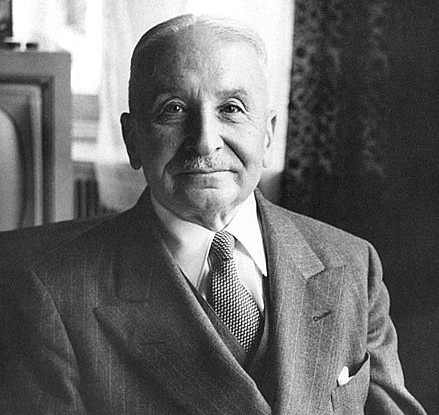
Abstract
The core of the project is a systematic, comprehensive review of extensive archival holdings that have been stored in Moscow for decades and were found by the project leader, which document the work and activities of Ludwig v. Mises, especially in the interwar period. In the course of the project, the entire file inventory is also to be digitally recorded and made digitally accessible to research under the aegis of the Graz Schumpeter Centre at the University of Graz.
As initial findings suggest, these documents are likely to prove interesting with regard to a number of issues that have been the subject of particularly intensive discussion in international research over the past decade. These include the following central questions of economic policy as well as specific aspects with regard to economic theory, which are to serve as the focus of the project's content review:
- Monetary, credit, financial and stabilisation policy.
- Supranational governance.
- Economic accounting, market prices and their significance for civilisation.
- The Konjunkturforschungsinstitut and its strategic importance for the development of the Austrian School..
- Theory, practical impact and policy advice.
Participating institutions


Links
- OeNB Anniversary Fund
This project is funded by the OeNB-Anniversary Fund.
- Graz Schumpeter Centre
This projected is located at the Graz Schumpeter Centre.
- Forschungsportal Graz Schumpeter Centre
Click here for the research portal of the Graz Schumpeter Center.